Tuesday, October 15, 2013

The Pirate Years, Part IV: A New Vision of Amblyopia

I am happy to get a moment to give an update on Joey's condition and on her progress. Today was a big day, and I am a bit overwhelmed...and nauseous. But I'll get to that in a minute.

For the last few months there hasn't been much to say. Summer activities and a bizarre severe viral infection made patching impractical. Joey's doctor determined that patching probably wouldn't help her; this also left us with little energy for the project.

Last the spring, her doctor pointed us to a recent study that showed some promising results, and took place right in our back yard. The therapy involved video game play during patching therapy, and the results were impressive. The study produced significant improvement even for adult amblyopia patients (whom medical wisdom deems too old for effective treatment). In this particular study, some patients showed an amazing 50% improvement in vision after 40 hours of therapy, sometimes even less.

The research was headed up by Dr. Roger Li of UC Berkeley, Bret's alma mater, my summer employer, just a half hour's drive away. After a few months of information exchanges, we were able to get Joey in for an evaluation to participate in their current clinical trial.

Joey at the initial evaluation.
The evaluation itself was somewhat grueling; though youth is on her side developmentally, Joey would probably be better able to handle the tasks if she were just a bit older. She worked for 45 minutes at "What letter do you see?", patched and unpatched. This, for a child who has just recently gotten a firm handle on all the letters even when she can see them, definitely stretched her capacity. She did qualify for the study, however. Now the fun begins.

Today was her trial therapy session. For the first 15 minutes, we played a 3D game together on a PS3. This is somewhat unfortunate, as Bret and Colin are the real gamers in the family; Joey loves to watch and understands game play very well, but has undeveloped controller skills. Gaming left me behind with the introduction of 3D navigation (which was, when? 1996?). I've spent countless hours stuck against walls ever since. And yet I am her guide, poor thing.

So we played for 15 minutes with glasses on and no patch, then took a 15 minute break. The graduate students delighted her with Legos and candy. Then the hard work began; we played the game with a patch, regular glasses, and 3D glasses....It was a lot of weight for her little ears to bear, and significantly more taxing on her eyes. I played more this time, just keeping the game play going so she would keep watching and helping. She claimed she couldn't see anything, but would then tell me to "go pull the handle" and explained that "the meter will refill itself," so we knew she was seeing a little better than she was letting on.

She left the session unfazed and pleased with her pack of Smarties; I left ready to vomit. We rushed from campus back to the car, back home, just in time to get Colin from school. This will be our routine for the next 4 weeks, for 20 sessions. If she shows progress, we keep going.

The logistics will be challenging, and I'm sure that the travel will begin to wear on us after a while, pinching our time to get other things done. We are lucky to have this alternative to explore, however, and I am happy to be a part of research that brings amblyopia therapy out of the dark ages. Even if the end result is that Joey personally experiences no improvement, this is just one of those things we would regret not doing.

In a few days we return to meet Dr. Li personally. The grad students working with us admitted that her case is severe; they placed her vision back at 20/400, with mild astigmatism to boot. (Really, isn't being mostly blind enough?) It will be interesting to hear what Dr. Li has to say.

For the next few weeks, I guess we have a lot of gaming to do.


Thursday, March 28, 2013

The Pirate Years, Part III: Five (Maybe Not So) Dumb Things I've Done to Get My Daughter to Wear a Patch

Part III in the sage of Joey's vision development. Once the drama of cataract surgery and the early days of recovery passed, we got on with the business of amblyopia therapy. We were charged with 6-8 hours of daily patch therapy, in the hopes of improving her brain's willingness to read the signals from her amblyopic, 20/400 vision eye.

That business isn't an easy one to be in.

An average preschooler, if given the choice between being able to see well or poorly, will choose sight. A preschooler, given the ability to remove an impediment to vision, will avail herself of the opportunity to do so, and will resist all attempts to reinstate the impaired state. And her mother, under dire orders to enforce vision impairment for 6-8 hours of each of her darling preschooler's days, will sink slowly into madness in the effort.

"We just have to get creative," says the mom in My Travelin' Eye, a favorite children's book about amblyopia. And so we did.

Five (Maybe Not So) Dumb Things I've Done to Get My Daughter to Wear an Eye Patch


1. Enlist the Help of Friends

Joey wearing her favorite of all of our "friend patches."
Okay, so this is probably the least dumb of all of the things I've done. While Joey was still healing from surgery, I send packets of patches to family and friends and asked them to decorate them for her. They mailed them back to us for Joey to wear, often with very kind notes. We received the most amazing, creative, beautiful, bizarre sets of patches we could have imagined. They delighted her, and Bret and I "felt the love" through these patches as we struggled in those early days.

2. Make a Scrapbook

"Crafty" is definitely not a word one would find on my elementary school "describe yourself with words using each of the letters of your own name" activities. At three years old, Joey had better instincts for crafting possibilities than I do. But here we were, with dozens of lovingly created patches by all of our friends, and nothing to do with them after their use. So, we put together a book in which she could place each patch next to a picture of the person who made it for her. As a specimen of the art of scrapbooking, it's pretty s-crappy, but even now, two years later, she loves to look through the pages and see the patches and the friends and family who made them for her.

3. Wear a Patch Myself

Living with very young children is like trying to breath with your head sticking out the window of a car on a freeway. If you concentrate, center yourself, and imagine success, you can do it, but one moment of inattention to the whipping of the wind and your eyes go bleary and your hair is a mess and you end up with a bug up your nose. And that's on a normal day. Add hours of therapy for as long as is possible, and let the gasping begin. It takes so little to throw us off the road--a drippy nose, travel, or just one of those bad days that 4-year-olds have--and the result is, more often than not, less than adequate. Each time we are forced to take a hiatus of a week or two, starting again is like starting over, and starting over requires new gimmicks, new games, and new distractions to make therapy happen.


At just one of these times, I decided to patch with Joey on days when I could. Much like shaving one's head to show solidarity with a loved one going through chemo, I hoped to show my solidarity and make her feel less alone during patch time. I'm pretty sure I did neither of these things, but there were lessons for me to learn from the experience.

From patching with Joey, I learned, as much as would be possible, what it is like to try to function with the use of just one eye. Not surprisingly, for someone not accustomed, it is incredibly difficult. I'm already a pretty clumsy person, but the loss of peripheral vision and stereo vision made many important tasks--measuring, pouring, stirring, moving dinner from pan to plate--downright hazardous, if not plain foolish. What I did not expect to learn was how tiring it was. Not after a few hours, but mere minutes after putting on the patch, my body would simply shut down.....I was physically exhausted, almost paralyzed. We had often seen the same reaction in her, but chalked it up to the struggle just to get the patch on and to general preschooler resistance. But I suffered from the same fatigue, some kind of psychological protectionism of the body, each time I put the patch on. Since my stint of patching with Joey, I've been much more sympathetic about the times when I ask her to patch, and I consider more carefully what other demands we will also be placing on her during those times.

4. Decorate with Patches

What? It's butterflies, and flowers, and grass....
Despite my crippled inner artist, being crafty seems like the only inroad with Joey and her patches. (In fact, in almost all matters is this true with Joey.) And so back to the craft store we went for yet another therapy re-boot. I had heard of parents who drew elaborate murals for their daughters, life-size princesses for which the patches were the ruffles on their skirts....I could match none of these things, and my effort at creating a picture with patches was pretty pathetic indeed.

One thing I do have going for me, however, is that I am a teacher, and as such unabashed in my willingness to teach something with everything I do. Joey loves numbers, and so we made up some counting pages, using the patches as our units of measure.
What's wrong with this picture? Joey knows; she did it herself, "because it's fun that way."
These two projects exhausted my capacity for creativity. Luckily for me, you can buy art. Maybe not Picasso, but art good enough to put patches all over. I will be forever grateful to the folks at Ortopad, who saved me from my nightmares of 8th grade crafts class and had the genius to make a drawing intended to be filled in with eye patches. Which leads us to #5.

5. Reward a Child Who Does Not Yet Understand Rewards; and then Reward a Child Who Does Understand Rewards

The problem with rewards for young children is that it presupposes an understanding of cause and effect, of delayed gratification, of a willingness, not just to do, sometime, something that might, some day, earn you something cool; but to do, right now, something you deeply dislike on the not-yet-often-tested promise that, someday, you'll get something cool. These skills are paper-clip-chain strong in a 4-year-old, and just as likely to stand up to daily use. Both of my kids have proven late-bloomers when it comes to being willing to suffer in the "now" for the benefit of the "later." And yet we persist with stickers and charts and every bit of such nonsense, often long before our kids were ready for them.

Ortopad makes great patches, too, cute, effective, and, most importantly, with glitter.
It has been an interesting exercise. When we started the chart above, three or four months ago, Joey had very little grasp of the reward element, and while she was content to put the patch on the chart after we had (in some other way) convinced her to wear it, she would be somewhat dumbfounded when she reached the "10" or "20" mark and she got a prize. The prize was always welcome, of course, but in those early days it was clear that the cause and effect connections were absent.

She completed this chart yesterday, and by those last few patches she knew what it meant each day to wear one; she knew that she was one step closer to the final goal, and she was, at least some days, willing to overcome her own natural resistance for the purpose of that goal. I'd be proud if I didn't know that nothing that I have done has had anything to do with her reaching that developmental milestone, but it is still pretty cool to watch it develop over time.


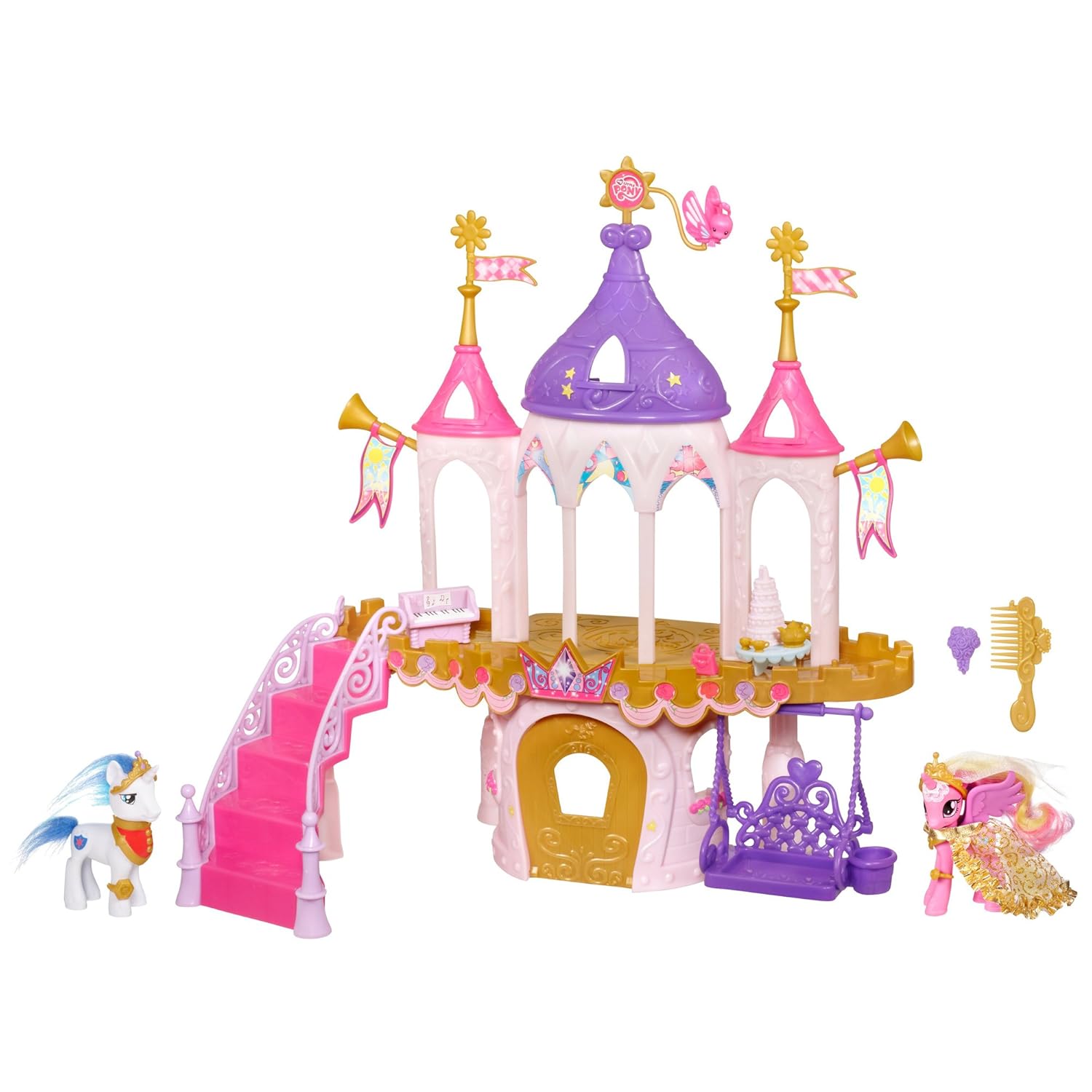
Of course, having a child who understands rewards means having a child who understands that rewards should be something she wants, and not necessarily something that Mom wants her to have, and so we are now proud owners of this fine piece of gender-stereotyping commercialism, the My Little Pony Royal Castle Playset. On the list of dumb things I've done to get my daughter to wear a patch, this borders on deserving to be #1.


UPDATE:
I am mostly catching up in time in these posts, but there have been recent developments. Sadly, Joey's cataract has begun growing again (or never continued to stop), enough that she sees spots of darkness in certain kinds of light. (True to form, Joey describes these shapes in an almost daily rotation of creatures: teddy bear, penguin, tarantula....Most recently it has been a fish. It is a blessing that she is not at all disturbed by these visual companions.) Because her own lens has mostly been removed and replaced with a plastic one, these shadows are likely to remain at the periphery of her vision and, hopefully, will not impede any development.

In fact, her vision improved this last visit, startling both me and her doctor when she correctly identified the letter one size smaller than the "big E" on the eye chart. Her vision in her amblyopic eye now stands at 20/300. That's a long way from regular sight, and still isn't correctable with glasses, but given that we thought progress was, quite possibly, impossible, it was heartening news.

In addition, we are somewhat optimistic about some new research in vision therapy. I'll share some of what we have learned in the next post, which will also feature...kittens!

Wednesday, August 29, 2012

The Pirate Years, Part II: Let the Trauma Begin!

What happens next, after your 3-year-old has cataract surgery, having, so far having lived more days with obscured vision than without?

She is unhappy, miserable really, in pain, and mostly unable to understand the what and the why of 12 eye drops a day, a plastic shield taped to her face, and a whole lot of medication. (For all of that, she could be as adorable as ever. Here's a little movie to prove it.) The eye drops were the worst--some were painful, some not, but the lesson is quickly learned, and within a few days it took two people to pin her down to get them in. As we weaned off them, we were able to start giving them to her while she was asleep, a tricky task which sometimes ended in nightmarish battles that we joked (but really feared) would give her a twitchy sleep complex later in her life. A year later, eye drops are still the worst possible punishment for her--a bout of pink eye, and the 3 times per day eye drop medication for it, revealed that she has not forgotten, may never forget, the trauma of the surgery and the month of physical recovery which followed.

After that month, though, the drops were over, the pain was gone, and the long term reality set in. The cataract removed and replaced with a plastic lens, Joey is left with, in effect, a case of amblyopia, commonly, "lazy eye." This condition can develop for a variety of reasons, but the ultimate result is that the neurological pathway between the eye and the brain has not developed fully, so that the brain "ignores" the signals that the eye sends. The physical effect of amblyopia is a wandering or "lazy" eye. The therapy for amplyopia dictates that you occlude the vision of the strong eye in order to force the brain to use only the signals it receives from the "lazy" eye. This involves "patch therapy," a seemingly primitive sort of medicine in which a patch is placed over the strong eye to block its vision. It sounds obvious and simple, and yet it is a most incredibly difficult thing to do.

Upon first patching Joey, we discovered that Joey's condition of amblyopia was more severe than the norm, an indication that her cataract had been present very early in life. So not only did her eye "wander," it did not have what they call "central fixation," which keeps the eye centered. With the guidance of her good eye, her amblyopic eye would stay in place; with her good eye patched, her amblyopic eye would do this:
Creepy, isn't it?

Okay. So a few things might bear explaining. The patches can be decorated, and one of Joey's favorite patch decorations are googly-eyes. Unfortunately distracting for this example, but it is the only good picture we have of her from this period. Putting that aside, one can see the other eye shooting off to the side. She is not trying to look off to the left--this is all her eye could do, for almost a month. When she wanted to look out of it, she would have to turn her entire head to the side to align her eye with what she wanted to see.

We had one more month of hand-wringing and waiting: in this period, the eye would either fix centrally, or it would not; if it did not in the short term, it most likely never would. One can only imagine the scrutiny, the hoping, the waiting. Time did its job, in this case, and though it still desperately wanders whenever she is fatigued, her eye did ultimately "fix" centrally.

Unlike other cases of amblyopia (as I understand them), Joey's is unique in that the vision in her impaired eye is so poor--20/300--that her brain quite simply wants very little to do with the signals it sends. (See a simulation of impaired vision here.) Even patched, Joey's brain will sometimes prefer to see the back of the patch rather than see what her impaired eye sees. She will sometimes say that she can't see anything, or that she can only see "black lines": light seeping through the patch onto her good eye. Simply put, there is no reward or punishment in a preschoolers little world that is enough to combat the discomfort, the limitation, and the frustration of not being able to see when, in all truth, and in her own mind, she knows that, in any given moment, she can. Not surprisingly, patching is an effective treatment for amblyopia, but compliance is the greatest barrier to its success.

A year has passed. Nothing has changed. Rather, a lot has changed: Joey is now four, and why no one speaks of the peculiar nightmare that is raising a four-year-old girl I do not know. Despite (or because of) intermittently successful patching, Joey has had no improvement in the vision in her eye. We tried dilation therapy for a short time, and alternative therapy in which the good eye is dilated with atropine--just like in the eye doctor's office--in order to minimize the contrast between being patched and not patched, thereby (in theory) decreasing the frustration with wearing the patch. (Dilation therapy can be used as an alternative to patching in patients whose vision is better than Joey's, but in our case dilation alone would do not good. As it turns out, dilation and patching also did no good.)
In a rare moment, Joey plays fairly successfully at a playground in her patch. 

Joey is proving herself a fierce opponent to patching. Many who know the sweet, light child she can be would be horrified at the monster unleashed at "patch time." Parents always endure unspeakable assaults from their children, sometimes expected, sometimes not. When Joey threw her boot at my face to avoid being patched, I think something broke inside me, and while I continue to do my best with the therapy, I struggle with how much psychological pain I am willing to inflict (both on her and on me), and what lengths I am willing to go through to implement a therapy which has such an uncertain chance of succeeding.

Over time, the pathways between a child's brain and her eyes become less pliable, and the window of opportunity for change will close. Sadly, Joey's doctor is somewhat pessimistic about her ability to improve; in his experience, fierce battles against patching do not cause a lack of improvement necessarily, but rather seem to indicate (as he put it) some innate understanding that there is no improvement to be had. Maybe this is something that he says to parents who find patching too hard of a battle to fight, to make them feel better about losing that battle more days than not. I don't know. The only thing left to do is to feel horrible about the days when we lose that battle, feel like the days when we get a little are not good enough, and always try for more, against the possibility that even perfect compliance may bring us no change at all. What else is there to do?

Next Up:

The Pirate Years, Part III: Fashion Patches are (Not So) Fun, or, Five Dumb Things I've Done to Get My Daughter to Wear a Patch

Friday, May 25, 2012

The Pirate Years, Part I: "Oh, yeah, my grandma had a cataract, too."

Given my penchant for using writing as cheap therapy, I was somewhat surprised to discover that I haven't written about my daughter's eye surgery. Maybe because I feel like I'm still living it, and sometimes living it takes all I've got. But the approach of the one year anniversary of the beginning of the whole ordeal has me pensive. I think it might be time to sit on the leather couch....Maybe doing so will help someone else.

The Discovery
Not quite since birth, but pretty close to it, Joey squinted. She seems pretty normal here, in September 2008, at 4 months old:


By 7 months, we have a lot more pictures that look like this:

It seemed not at all unusual for a child to squint in the sun. She was known as "Pirate Joey." Everyone seemed to agree that it was cute and quirky, and not one person ever suggested that it might be an indication that something was wrong.

Apparently, squinting is an indication that something is wrong. It is common among people with cataracts, and while cataracts are typically a condition brought on by age and use, children do develop them congenitally. (There is an entire public health campaign in the UK targeted specifically at childhood squinting. Not so here.) I will forever wonder how we made it two years without a single person suggesting a problem, or ourselves wondering about it enough to mention it to her doctor.

Two and a half years passed. I started to notice her eye drift a little when she was tired. Working in her preschool classroom at the end of the school year, I observed her watching her teacher, and noticed that she seemed to look in the direction of her teacher, but not really at her. Bad vision runs in the family, so it would have been no shock to find out that she needed glasses.

This photo is of Joey and Colin, around her 3rd birthday, in May 2011, just weeks before the discovery. Even here, I think few people would notice the squint if not pointed out. (One could argue that Colin is squinting equally with the other eye.) I guess I can take some comfort that it wasn't so obvious, even right before we learned what was happening.

Luckily, Joey's three-year-old routine doctor's appointment was coming up, and it is at this appointment that they typically do the first eye test. (I presume that, at three, kids can finally follow instructions well enough that their answers to "What do you see on the chart?" can be trusted.) Right eye, all is well. She sees a star, a boat....Left eye, and I get a look from her like we just changed languages. Eye chart? What eye chart? her expression asks. Off to the specialist we go.

This alone might have been scary. But oddly enough, we had been to this same eye specialist before, for Colin. (He has a bump on the white of one of his eyes, a nerve, we learned, that just happens to end on the surface of the eye, creating a water blister-like spot. It's not painful, and is completely harmless. He's likely to have it for life.) So we had been there before with not much to worry about. The chit-chat was cordial and calm, some talk of glasses running in the family. Then the ophthalmologist dilated her eye. Suddenly, the conversation changed. She has posterior lenticonus: in simple terms, a cataract, like what older people get as their eyes age or if they have had repeated damage through years of use. Her vision is completely blocked. How long? Hard to say. Not since birth, but probably starting shortly after, some time in the first year. She needs surgery? When? As soon as possible. Within five minutes, I'm in a cramped little office, stacked with papers, talking with an assistant about surgery dates and discussing how to convince a just three-year-old that she can't have breakfast the morning before the surgery.

The Surgery
What else can be said? It was horrible. Worse than horrible. If given the choice, I'll never watch one of my children be put under general anesthesia again. They try to warn you....Anyway, half way through the surgery, they had to call me out of the lounge area....I cried all the way up the elevator, in a panic, having no idea what was wrong. A woman, concerned about the health of her child, who stood beside her, pressed me on my sniffling....Was I sick? Did I have allergies? If not, then what was the matter with me, and could I give it to her child? No, my daughter is in surgery, having her left eye's lens removed, a plastic implant inserted if all goes well, and maybe, maybe getting the chance to see normally. Thanks for asking, though.

About six weeks later, at the end of July, 2011, we find ourselves here:

Looking at this picture just makes me cry.

Next Up: The Pirate Years, Part II: Floating Eyes and Fashion Patches